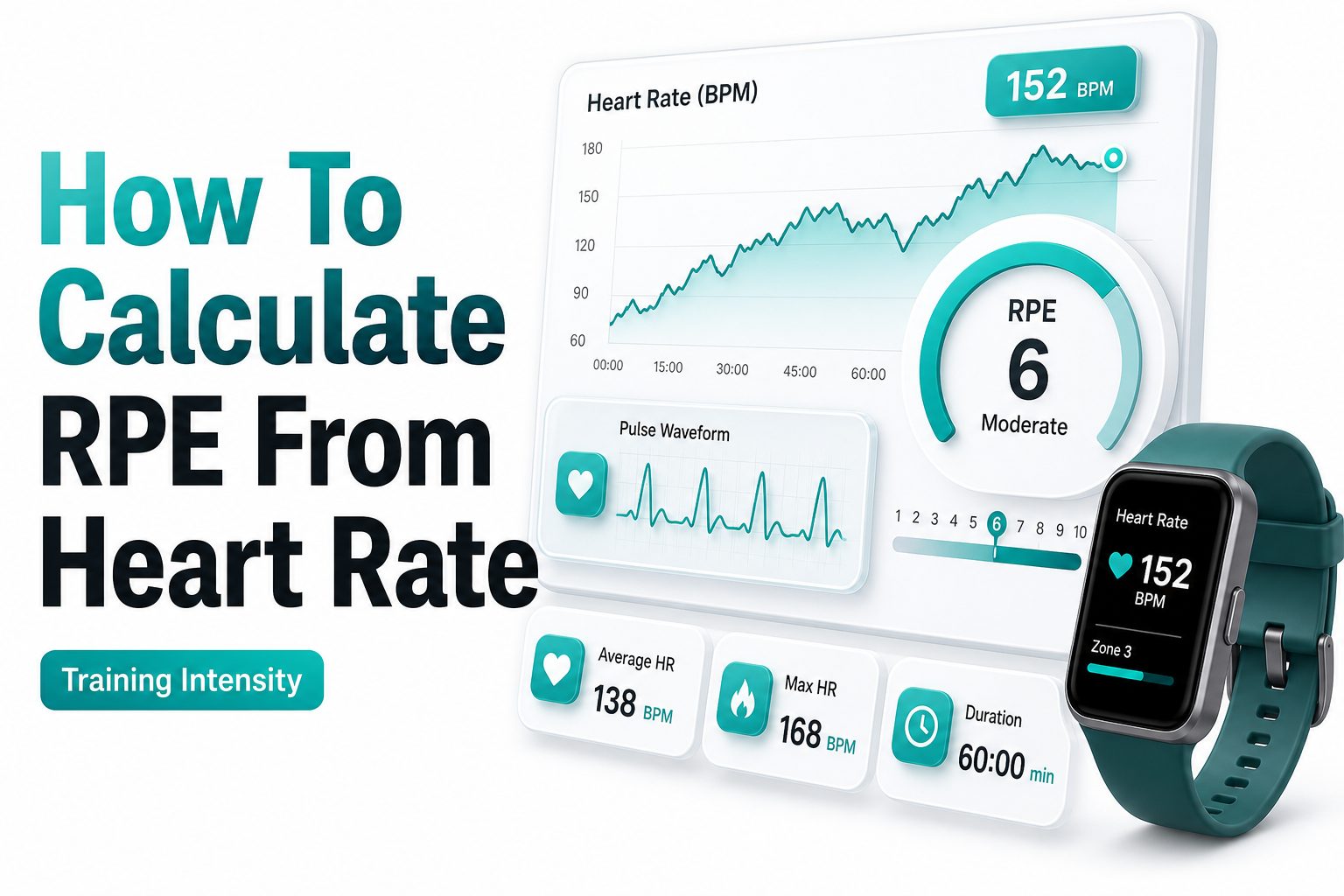
Learning how to calculate RPE from heart rate helps athletes, fitness beginners, and coaches connect internal effort with measurable training data. Heart rate gives a number, while RPE adds personal context about fatigue, stress, heat, recovery, and workout difficulty.
RPE stands for rate of perceived exertion. It measures how hard exercise feels, usually on a scale from 1 to 10 or 6 to 20. Heart rate measures beats per minute, showing how strongly the cardiovascular system responds during movement.
The goal is not to replace heart rate with RPE. The real value comes from using both together. When heart rate and effort match, training feels controlled. When they do not match, the body may be signaling fatigue, dehydration, poor sleep, or stress.
What RPE Means in Training
RPE gives structure to physical effort without needing equipment. A low RPE feels easy and conversational. A moderate RPE feels steady but controlled. A high RPE feels challenging, with limited speech and a strong desire to slow down.
The 1 to 10 RPE scale is common because it is simple. RPE 1 means very light activity, while RPE 10 means maximum effort. Most general fitness sessions fall between RPE 4 and RPE 8, depending on the workout goal.
The older Borg scale runs from 6 to 20. It was designed to roughly match heart rate when multiplied by 10. For example, an RPE of 13 may reflect about 130 beats per minute for some people during steady aerobic work.
Key RPE Scale Reference
- RPE 1 to 2: Very easy effort, warm-up pace, light walking, full conversation
- RPE 3 to 4: Easy aerobic effort, comfortable breathing, sustainable for a long time
- RPE 5 to 6: Moderate effort, steady breathing, talking becomes shorter
- RPE 7 to 8: Hard effort, focused breathing, short phrases only
- RPE 9: Very hard effort, near maximum, difficult to maintain
- RPE 10: Maximum effort, short duration, no reserve left
How Heart Rate Measures Exercise Effort
Heart rate shows how many times the heart beats each minute. During exercise, the heart beats faster to deliver oxygen and nutrients to working muscles. Higher intensity usually creates a higher heart rate, although the relationship is not always perfect.
Many people use heart rate zones to guide workouts. These zones are usually based on maximum heart rate or heart rate reserve. Zone 1 feels easy, while Zone 5 represents very hard effort near maximum capacity.
Heart rate is useful because it provides objective feedback. A watch, chest strap, or sensor can show changes during exercise. Still, heart rate can be affected by caffeine, temperature, hydration, medication, altitude, illness, and emotional stress.
The Basic RPE and Heart Rate Connection
The easiest way to connect RPE and heart rate is through percentage of maximum heart rate. A lower percentage usually matches a lower RPE. A higher percentage usually matches a higher RPE, especially during steady cardio sessions.
For many people, RPE 4 may match about 60 percent of maximum heart rate. RPE 6 may match around 70 to 80 percent. RPE 8 may match around 85 to 90 percent, depending on fitness level and exercise type.
This connection works best during rhythmic aerobic exercise, such as running, cycling, rowing, or brisk walking. It becomes less exact during strength training, intervals, heat exposure, or workouts with frequent stops and changes in movement.
Simple Conversion Guide
- 50 to 60 percent max heart rate: RPE 2 to 3, very light to easy
- 60 to 70 percent max heart rate: RPE 3 to 4, easy aerobic effort
- 70 to 80 percent max heart rate: RPE 5 to 6, moderate training effort
- 80 to 90 percent max heart rate: RPE 7 to 8, hard effort
- 90 to 100 percent max heart rate: RPE 9 to 10, near maximum effort
Step One Estimate Maximum Heart Rate
To calculate RPE from heart rate, begin with an estimated maximum heart rate. A common formula is 220 minus age. For a 40-year-old person, estimated maximum heart rate would be 180 beats per minute.
Another formula is 208 minus 0.7 times age. This often gives a more balanced estimate for adults. For a 40-year-old, the result is 180 beats per minute, which matches the simpler formula in this example.
These formulas are estimates, not exact measurements. Two people of the same age can have different maximum heart rates. Fitness level, genetics, medication, and testing conditions all influence the final number during real exercise.
Step Two Find Heart Rate Percentage
After estimating maximum heart rate, divide current exercise heart rate by maximum heart rate. Then multiply by 100. This gives the percentage of maximum heart rate being used during the workout.
For example, if maximum heart rate is 180 and current heart rate is 144, the calculation is 144 divided by 180. The result is 0.80. Multiply by 100, and the person is training at 80 percent of maximum heart rate.
That percentage can then be matched with an RPE range. At 80 percent of maximum heart rate, many people feel around RPE 6 to 7. The workout should feel moderately hard to hard, but not like an all-out effort.
Quick Calculation Example
- Estimated maximum heart rate: 180 beats per minute
- Current workout heart rate: 144 beats per minute
- Calculation: 144 divided by 180 equals 0.80
- Percentage: 80 percent of maximum heart rate
- Estimated RPE: around 6 to 7 on a 1 to 10 scale
Step Three Match Percentage to RPE
Once the percentage is known, compare it with a practical RPE chart. If the result is 65 percent, the effort may feel easy to moderate. If the result is 85 percent, the effort may feel hard and focused.
This method creates a useful starting point, but the body still gives important feedback. If heart rate says RPE 5 but the effort feels like RPE 8, the session may be affected by fatigue, poor sleep, heat, or low recovery.
A good approach is to record both numbers after workouts. Over time, patterns appear. You may notice that your RPE drops at the same heart rate as fitness improves, or rises during stressful weeks.
Using the Borg 6 to 20 Scale
The Borg 6 to 20 scale can be linked more directly to heart rate. Multiply the Borg RPE number by 10 to estimate heart rate. For example, Borg RPE 12 may roughly match 120 beats per minute.
This works best for steady aerobic exercise in healthy adults. It is less reliable during short sprints, heavy lifting, illness, or medication use. Still, it remains useful because it blends perceived effort with a heart rate-style number.
If your heart rate is 150 during a steady run, the Borg estimate may place you near RPE 15. That usually means hard but manageable effort. You are working strongly, yet not necessarily at maximum intensity.
Borg Scale Conversion Notes
- Borg 9: Very light effort, roughly near 90 beats per minute
- Borg 11: Light effort, steady and comfortable
- Borg 13: Somewhat hard, controlled aerobic work
- Borg 15: Hard effort, focused and demanding
- Borg 17: Very hard effort, difficult to sustain
- Borg 19 to 20: Near maximum to maximum effort
Why RPE and Heart Rate May Not Match
Heart rate and RPE do not always rise together. On hot days, heart rate can be higher than normal even when pace feels easy. This happens because the body works harder to cool itself during exercise.
Fatigue can also separate the two numbers. After poor sleep or heavy training, a normal heart rate may feel harder than expected. In that case, RPE gives useful context that the heart rate number alone may miss.
Caffeine, dehydration, stress, altitude, and some medications can change heart rate response. Strength workouts can also feel very hard while average heart rate stays moderate. This is why RPE should be treated as a real training signal.
Best Workouts for This Method
Calculating RPE from heart rate works well for steady cardio. Running, cycling, swimming, rowing, hiking, and elliptical training all create a smoother heart rate response. These activities make it easier to compare effort and heart rate zones.
It can also help with tempo workouts. If your target is RPE 7, heart rate can confirm whether the pace is controlled or drifting too high. This makes pacing more consistent across long sessions.
For interval training, heart rate may lag behind effort. A short sprint can feel like RPE 9 before heart rate peaks. During recovery, heart rate may stay elevated even after effort feels easier.
Good Use Cases
- Long aerobic runs or rides
- Zone 2 endurance sessions
- Tempo workouts and threshold training
- Cardio sessions during weight management
- Return-to-training phases after time off
- Monitoring fatigue across a training week
How to Use RPE With Heart Rate Zones
Heart rate zones provide structure, while RPE helps personalize the session. Zone 2 may be planned as easy aerobic work, but it should also feel conversational. If Zone 2 feels unusually hard, the body may need a lighter day.
Zone 3 usually feels moderate, with controlled breathing and steady effort. Zone 4 feels hard and focused. Zone 5 feels near maximum and is usually reserved for short intervals or performance-focused sessions.
For more detail, compare this approach with a heart rate zone training guide. Linking both tools helps you avoid relying only on pace, speed, or calories, which can shift based on terrain, weather, and daily readiness.
How Fitness Level Changes the Numbers
As fitness improves, the same heart rate may feel easier. A beginner may feel RPE 7 at 150 beats per minute, while a trained athlete may feel RPE 5 at the same heart rate. Conditioning changes how effort is perceived.
Training also improves efficiency. The heart can pump more blood per beat, muscles use oxygen better, and breathing becomes more controlled. This is why tracking RPE over time can show progress beyond pace or distance.
Beginners should avoid judging workouts only by high heart rate. New exercisers often reach elevated heart rates quickly. RPE helps keep training reasonable, especially when building consistency and avoiding early burnout.
Practical Tracking Method
- Record workout type and duration
- Note average and peak heart rate
- Add RPE for the full session
- Add RPE for the hardest part
- Write one short note about sleep, stress, heat, or soreness
- Review trends every two to four weeks
Common Mistakes to Avoid
One common mistake is treating estimated maximum heart rate as a fixed truth. It is only a starting point. If training feels very different from the zone chart every session, the estimate may need adjustment.
Another mistake is ignoring RPE because a device shows a certain zone. Wearables can be helpful, but sensors can lose accuracy. Wrist-based monitors may struggle during fast movements, cold weather, or exercises involving gripping.
Some people also push every workout into high zones. This creates fatigue and limits long-term progress. A balanced plan includes easy, moderate, and hard days, with RPE used to keep each session aligned with the goal.
RPE for Weight Training and Circuits
Heart rate can rise during lifting, but it does not always reflect muscular effort. A heavy squat set may feel like RPE 8 even if average heart rate is not extremely high. Muscle strain and cardiovascular load are different signals.
For strength training, RPE often refers to reps in reserve. RPE 8 may mean you could perform about two more reps with good form. This is different from cardio RPE, but both measure effort in practical terms.
Circuits combine strength and cardio, so heart rate may be useful again. Still, local muscle fatigue can make effort feel higher than heart rate suggests. In these sessions, use both numbers and prioritize safe movement quality.
When to Adjust Training Intensity
If heart rate is higher than usual at an easy RPE, consider heat, caffeine, dehydration, or stress. You may continue if the effort feels comfortable, but reducing pace can keep the session aligned with recovery or endurance goals.
If RPE is higher than expected at a normal heart rate, fatigue may be present. This can happen after poor sleep, hard training, illness, or long workdays. A lighter session may support better progress than forcing intensity.
If both heart rate and RPE are high, the workout is clearly demanding. That may be suitable for intervals, races, or hard training days. It should not become the default intensity for every session.
Internal Links for Better Training Context
To build a stronger training plan, pair this method with a cardio endurance training guide. That type of resource can help you decide when to train easy, when to push harder, and how to organize weekly volume.
You can also use a fitness recovery guide to compare RPE changes with sleep, soreness, nutrition, and stress. Recovery patterns often explain why the same heart rate feels different from one workout to another.
Internal links should support the reader’s next step. A person learning about RPE and heart rate may naturally need related guidance on heart rate zones, endurance planning, recovery habits, and beginner-friendly workout structure.
Sample Workout Using RPE and Heart Rate
Start with a 10-minute warm-up at RPE 2 to 3. Heart rate should rise gradually into an easy zone. Breathing should feel relaxed, and conversation should be possible without strain.
Move into 25 minutes at RPE 5 to 6. Heart rate may sit around 70 to 80 percent of maximum. This should feel steady, productive, and controlled, without the sharp discomfort of a hard interval.
Finish with five to ten minutes at RPE 2. Heart rate should come down steadily. After the session, write down average heart rate, peak heart rate, overall RPE, and any note that explains how the workout felt.
Conclusion
Using how to calculate rpe from heart rate gives you a practical way to connect numbers with real effort. Heart rate shows cardiovascular response, while RPE adds context from breathing, fatigue, stress, heat, soreness, and overall readiness.
Start by estimating maximum heart rate, calculate the percentage of your current heart rate, then match that percentage with an RPE range. Over time, this method becomes more accurate because your own training notes create personal reference points.
The best results come from using both tools together. Heart rate can guide structure, and RPE can guide judgment. When the two signals are tracked consistently, workouts become easier to adjust, compare, and improve.
FAQ
What is the easiest way to calculate RPE from heart rate?
Estimate your maximum heart rate, divide your current exercise heart rate by that number, then multiply by 100. Match the percentage to an RPE chart. For example, 80 percent of maximum heart rate often equals about RPE 6 to 7.
Is RPE more accurate than heart rate?
RPE is not always more accurate, but it adds context heart rate cannot show alone. Heart rate gives objective data, while RPE reflects fatigue, heat, stress, soreness, and breathing. Using both usually gives a clearer training picture.
Can beginners use RPE and heart rate together?
Yes, beginners can use both from the start. Heart rate provides structure, while RPE helps prevent overtraining. Beginners often reach higher heart rates quickly, so perceived effort can help keep workouts comfortable, consistent, and easier to repeat.
Why does my heart rate feel harder some days?
The same heart rate can feel harder because of poor sleep, dehydration, heat, stress, illness, or previous training fatigue. If RPE is unusually high, reducing intensity may help keep the workout productive without adding unnecessary strain.
Does RPE work for strength training?
Yes, but strength training RPE is often based on reps in reserve rather than heart rate. A set at RPE 8 usually means about two good reps remain. Heart rate can help during circuits, but muscular effort matters more.
0 Comments